
Chiropractor for Kids, Babies & Children in East Auckland
Why We're Your Trusted Chiropractor for Kids
Because the relationship between the spine and the nervous system is foundational and that relationship is especially important in a growing body.
The first few years of life represent the most rapid period of brain development a human will ever experience. During this time, billions of neural connections are forming. Movement, sensory input, balance, coordination and environmental interaction all help shape how the brain wires itself. Optimal nerve system growth depends on clear, efficient communication between the brain and body.
As your paediatric chiropractor, chiropractic care focuses on supporting that communication.
Rather than “fixing” children, our goal is to assess spinal movement and nervous system function and help remove mechanical stress that may interfere with healthy development.

The Birth Process & the Newborn Spine: Why See a Chiropractor for Kids Early
Birth is extraordinary, but it is does not have a null effect on the body…
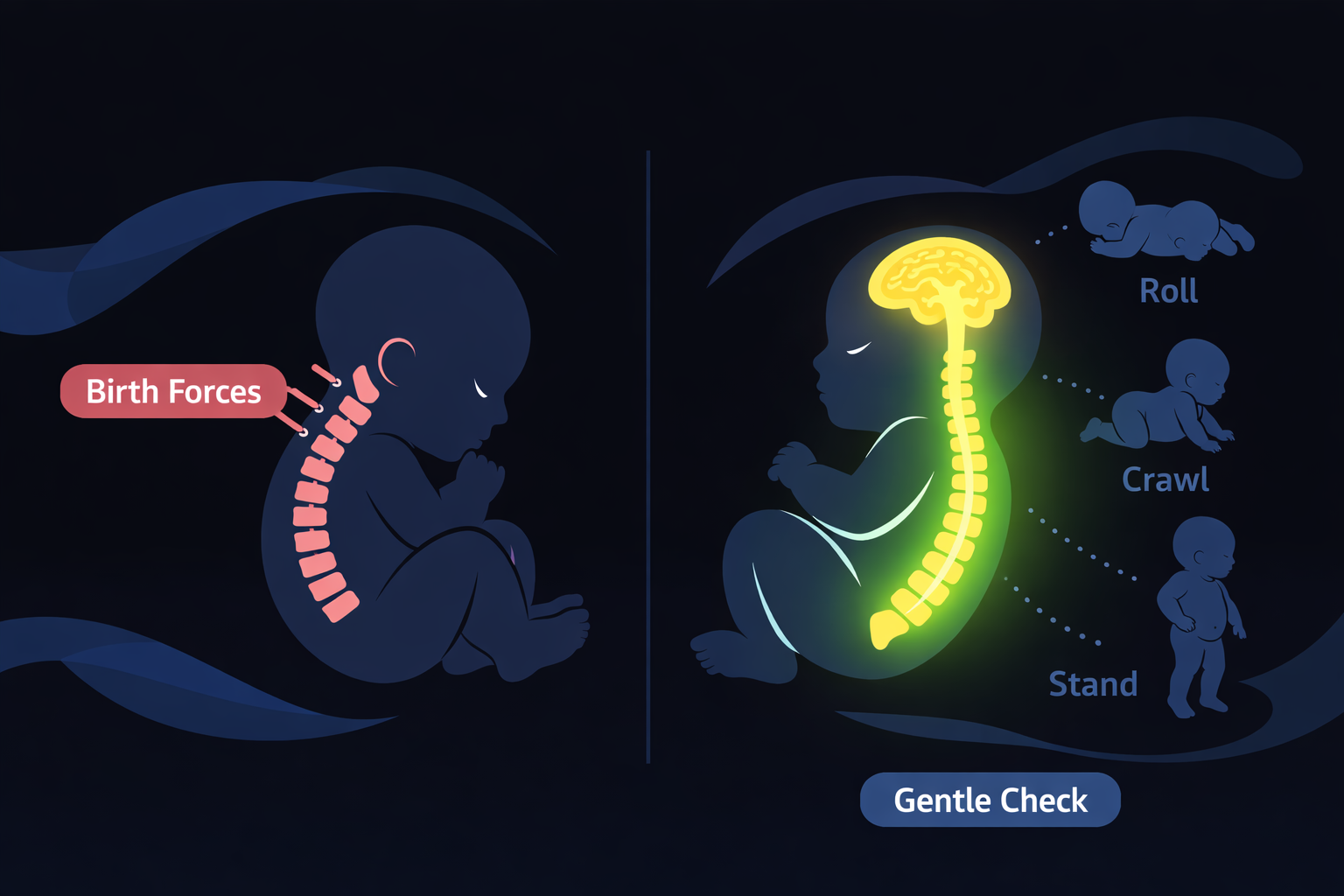
During labour (albeit natural!), significant compressive and rotational forces pass over the baby’s head and cervical spine. As part of the natural birthing process, babies rotate through the birth canal. In some cases, assistance such as forceps or ventouse may increase mechanical stress on delicate tissues. Research and clinical observation show that newborns frequently present with cervical tension or asymmetrical neck movement following birth. This is common. However, restricted motion in the upper neck can influence feeding comfort, head preference and early motor patterns.
A gentle assessment from a chiropractor for kids provides reassurance that your baby’s spine is moving freely from the very beginning.
Nerve System Development & Early Brain Growth:
The nervous system controls EVERYTHING! Feeding, digestion, sleep cycles, immune responses, muscle tone, coordination and other milestone progressions are all directed by the brain-body connection & its communication.
Neurophysiological research in adults demonstrates that spinal adjustments can influence sensory processing and brain function, including changes in sensorimotor integration and autonomic regulation. While infant-specific research continues to grow, the principle remains consistent. Healthy spinal movement contributes to optimal neurological input. Many parents seek a chiropractor for babies sleep issues, as improved nervous system function may support better rest patterns.
During infancy, when neural connections are forming at remarkable speed, supporting clear communication within the nervous system makes intuitive and physiological sense.
Movement Milestones and Micro-Trauma:
As babies grow, they move through rapid physical and neurological stages. Rolling, sitting, crawling, pulling to stand, walking, running and jumping are not just cute milestones. They are brain-building activities. Sometimes though, with movement comes bumps, tumbles and falls. Most are minor, but even small repetitive stresses can influence posture and movement patterns over time. Subtle asymmetries, such as favouring one side or developing flattening of the head, can become longer-term compensation habits if not addressed.
Early spinal assessments from your paediatric chiropractor help identify tension patterns before they become ingrained.
What Does the Research Say About Paediatric Chiropractic Care?

Research in paediatric chiropractic care is evolving and current literature suggests that spinal manipulative therapy may be associated with improvements in certain childhood conditions.
Systematic reviews have explored chiropractic care for babies sleep patterns, as well as colic, otitis media, musculoskeletal pain and developmental concerns.
Studies have also demonstrated that Chiropractic care can influence heart rate variability, a marker of autonomic nervous system regulation.
Improved autonomic balance is associated with better stress adaptation and physiological regulation.
Rather than positioning Chiropractic as a treatment for specific diseases, we focus on function. Improved spinal movement and neurological balance may support better adaptation, regulation and overall wellbeing!
Gentle, Appropriate & Family-Centered: Your Trusted Chiropractor for Kids
At Platinum Chiropractic, our Chiropractors are trained in assessing and adjusting tiny spines using extremely gentle, light touch techniques. The pressure used on a newborn is comparable to checking the ripeness of a tomato! Some of our babies over the years now DRIVE into the practice to see us :)
We love seeing families in our practice. Our space is welcoming, relaxed and equipped with books, toys, puzzles and games to help little ones feel comfortable. We believe proactive health care should feel supportive, not intimidating.
A Proactive Approach to Kids Growing Well:
Most of the babies and children we see with our chiropractor for kids are not "unwell." Their parents simply want to give them the best start possible.
You baby-proof your home. You research car seats. You choose nourishing food and safe products. Including a spinal and nervous system check with a paediatric chiropractor as part of your child’s early health care fits naturally into that proactive mindset.
Healthy growth is not something we leave to chance. It is something we support, gently and intentionally.
References
Alcantara J, Ohm J, Kunz D. The chiropractic care of infants with colic: A systematic review of the literature. Explore (NY). 2011;7(3):168–174.
Miller JE, Miller L, Sulesund AK, et al. Effect of chiropractic care on heart rate variability and pain in a multisite clinical study. J Manipulative Physiol Ther. 2021;44(5):347–357.
Fallon JM. The role of the chiropractic adjustment in the care and treatment of 332 children with otitis media. J Clin Chiropr Pediatr. 1997;2(2):167–183.
Ohm J. Chiropractic care for children. Journal of Clinical Chiropractic Pediatrics. 2010;11(2):844–847.
Gleberzon BJ, Arts J, Mei A, McManus EL. The use of spinal manipulative therapy for pediatric health conditions: A systematic review of the literature. J Can Chiropr Assoc. 2012;56(2):128–141.